


Mariupol Local Lore Museum
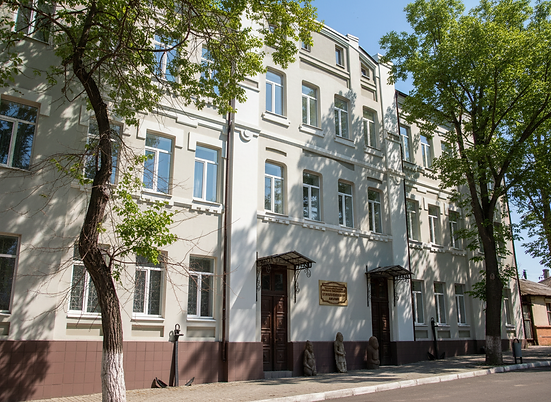
The history of the Mariupol Museum of Local Lore is very reminiscent of the history of its city, which was reflected in the museum exposition, fund collection, scientific and educational work. This history was filled with many bright creative moments, and sometimes, like now, sad and tragic ones.
Created in the turbulent revolutionary year of 1920, over its more than a century-old history, the Mariupol Museum of Local Lore has seen the burning enthusiasm of revolutionary transformations, being one of the active city centers of scientific and educational work, the spread of the ideological domination of the Soviet system, working, among other things, as one of the cogs of a large propaganda mechanism. The museum survived the occupation during World War II, preserving the vast majority of its exhibits. The museum building remained intact, which was a rarity for a city whose vast majority of buildings were burned by Hitler's troops during the retreat. But the pre-war staff of the institution was almost entirely lost for various reasons.
The museum grew and changed along with the city, creating new branches, collecting new exhibits and continuing its scientific work. Over the years of its activity, it changed its name and administrative affiliation several times - it was a county, district, regional, and municipal museum. At the same time, the museum was always not only a place where authentic objects are stored, but also tried to be a center for studying the region.
Its employees conducted and participated in archaeological excavations, natural and ethnographic research, and studied the climate of the region. The great merit of the museum employees, and above all I.P. Kovalenko, V.V. Rudevich and V.L. Golitsynsky, in the development of the environmental movement. Thanks to their initiative and perseverance, in 1926-1927 the first reserves in the region were founded: Khomutovsky Steppe, Kam'ani Mohyly, Belosarayskaya Spit. These territories became living open-air laboratories for studying the nature of the Nadazovye.
Museum workers studied the past and present of the city, opening new pages of Mariupol's chronicle, created exhibitions and expositions, gave lectures, and conducted numerous excursions and thematic events. In the first half of the 20th century, a taxidermy workshop and a meteorological station operated at the museum.
The 1950s and 1960s were both years of gains and losses for the Mariupol Museum. At that time, a significant number of museum items were transferred to the funds of the Donetsk Regional Museum. At the same time, the museum collection was replenished with original works by prominent artists, in particular A.I. Kuindzhi. And colleagues from the Odessa Historical Museum shared rarities significant for the Nadaz region: a portrait of Metropolitan Ignatius and Cossack weapons.
 1 Дом инвалидов. 9 мая 1917 г. |  Акт про відкриття Катеринославського губернського навчально-ремісничого будинку-притулку для інвалідів Першої світової війни. 15.11.1916 р | 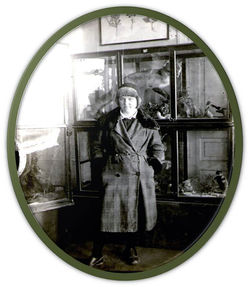 Експозиція 20-30 рр. ХХ ст. |
|---|---|---|
 Відділ природи |  В. В. Рудевич – педагог, співробітник відділу природи музею. |  Заняття музейного гуртка юних натуралістів. 20-і рр. XX ст. |
 Експозиція відділу історії |  Експозиція відділу природи. 30 рр. ХХ ст. |  Експозиція відділу природи. 20-30 рр. ХХ ст. |
 Листівка з призовом до громадян Маріуполя щодо організації музею. 1917 р. |  Співробітник музею Є.В. Четенов біля діорами «Хомутовський степ». 30-і рр. ХХ ст. |  Експозиція соціально-економічного відділу. Кінець 1920-х рр. |
 кспозиція природничо-наукового відділу. Кінець 1920-х рр. |
The museum went through a difficult and long period of transformation and rethinking of the Soviet past, the formation of new approaches to highlighting the historical past of the region, the creation of a pluralistic and objective narrative. In connection with the rethinking of the history of the Soviet period, it turned out that the museum exposition was rapidly becoming "outdated". In the 1990s, the face of the museum changed repeatedly. By the 10th anniversary of Ukraine's Independence, a new exposition of the Department of Modernity was opened. During 2016–2017, a new exposition "Mariupol at the Turn of the Epochs" was built in the Mariupol Museum of Local Lore, which represented the city during the Ukrainian Revolution.
Changes also took place in the structure of the museum, new branches appeared. The Museum of Folk Life has been operating since 1993. On October 29, 2010, the grand opening of the A. I. Kuindzhi Art Museum took place.
Large-scale changes that have taken place in and with the city in recent years, such as grandiose infrastructure projects, the development of the tourist sector of the economy, the introduction of modern technologies, all of this directly influenced the near-term prospects for the development of the city's museum industry. The beginning of the 20s of the 21st century was potentially a time of profound transformations and renewal for the Mariupol Museum of Local Lore, with major repairs and a full re-exhibition of the museum expected, which were planned in the near future.
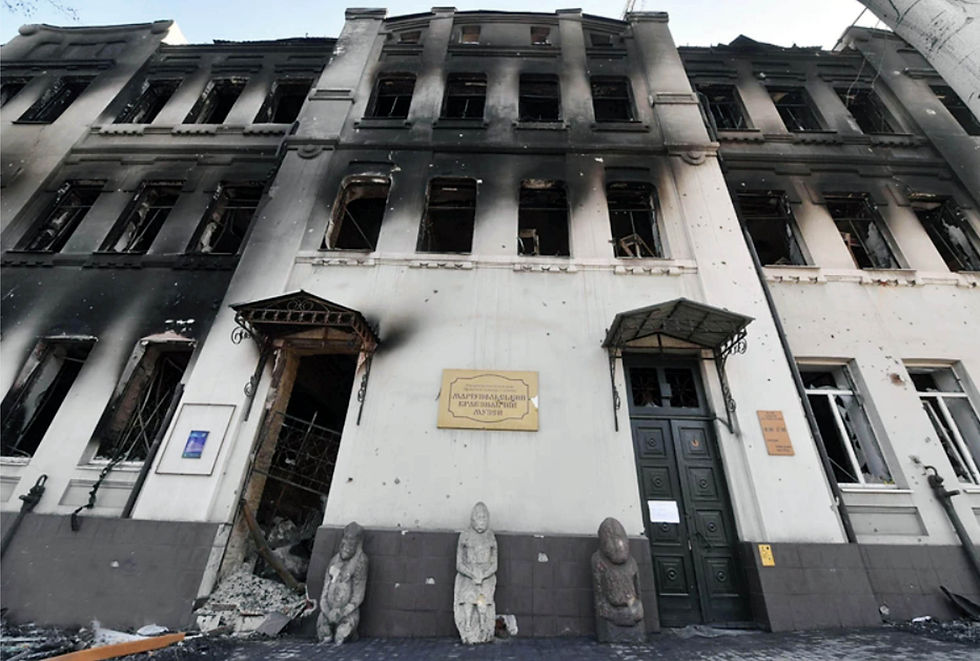
Everything changed with Russia's full-scale invasion of Ukraine.
The destruction of the Mariupol Museum of Local Lore during the Russian armed aggression is an immeasurable loss for both the city and the Museum Fund of Ukraine as a whole.
As a result of the full-scale invasion, thousands of houses were ruthlessly destroyed during the capture of Mariupol. The Mariupol Museum of Local Lore, located in the historic center of the city, was also subjected to shelling and bombing. As a result of repeated direct hits, a fire broke out in the building, which spread to all floors. The museum lost its exhibits and numerous collections. The branches of the museum suffered significant damage: the Museum of Folk Life and the A.I. Kuindzhi Art Museum, located on the same street as the Museum of Local Lore.
After the destruction and destruction of Mariupol museums, the occupiers took away the most valuable surviving objects from them, devastating the material historical and cultural heritage of the city and the region.
 Маріупольський краєзнавчий музей, експозиційні зали |  Художній музей ім. А. І. Куїнджі 23.03.2022 р. | 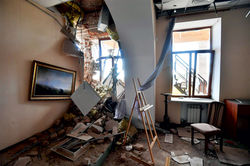 Експозиція Художного музея ім. А. І |
|---|---|---|
 1.6. Вивезення окупантами музейних експонатів у Донецьк. |  МНП 2022 р.-3 |
Today, the Mariupol Museum of Local Lore continues its work in evacuation and is looking for a new physical space for future exhibitions. The restoration of the city is the aspiration of many thousands of Mariupol residents, both those who were forced to leave the city and those who remained. The reconstruction and revival of the Mariupol Museum of Local Lore will be an important step in returning the city its historical memory and cultural heritage, a basis for the development and revival of a beautiful and flourishing region.