


Museum of Folk Life
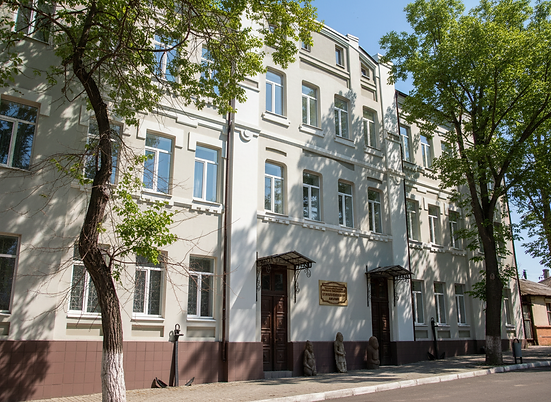
Museum of Folk Life
The Museum of Folk Life branch was rightfully considered a welcoming home of ethnography. Its interactive galleries explored the everyday lives, work, traditions, and leisure of our ancestors.
The Azov region has long been home to diverse peoples. The museum’s exhibitions vividly presented the similarities and differences in the lifestyles and cultural traditions of five major ethnic groups: Ukrainians, Greeks, Rusyns, Germans, and Jews.
The Ukrainian ethnography gallery recreated a traditional Ukrainian svitlytsia — a bright living room furnished with ceramic tableware, protective embroidered towels, and a chest filled with embroidered shirts. The recreated home of the Mariupol Greeks, who had been permanent residents of the region since the late 18th century, featured unique examples of their cultural heritage: woven textiles, copperware, traditional clothing, metal ornaments, and musical instruments.
Jewish culture was represented through religious artifacts, including a Torah, tallit, Hanukkah menorah, and other objects. The interior of a German settler’s home, with its finely carved wooden furniture and elegant porcelain tableware, evoked the atmosphere of Europe.
The open-display approach and the use of interactive objects allowed visitors to experience history through action: learning how food was prepared in a traditional oven, how clothes were ironed with a wooden ruble, how water was carried using a yoke, how people wrote with a quill pen, how iron was forged, and how pottery was made on a potter’s wheel.
During the warmer months, the Museum of Folk Life also welcomed visitors to its courtyard, home to working craft workshops — a blacksmith’s forge and a pottery workshop. Since 2018, the courtyard had regularly hosted the regional blacksmithing festival “Steel Spring.” Blacksmiths from Mariupol and the surrounding region demonstrated their skills and invited visitors to try their hand at this traditional craft.
The ethnographic branch received the name Museum of Folk Life on May 1, 1993. However, its history began much earlier.
In 1969, the Mariupol Local History Museum opened its first branch — the A. O. Zhdanov Memorial House Museum — in a historic building at 55 Heorhiivska Street, constructed in the late 19th century. Following the restoration of Mariupol’s historical name and the closure of the A. O. Zhdanov Memorial House Museum, the Department of Ethnography and Everyday Life of the Azov Region’s Residents was established there in 1989. From May 1989, the Museum of Ethnography and Everyday Life of the Azov Region’s Residents operated as an independent branch. Its long-time director was N. A. Tyrkalova, who had previously served as a senior researcher at the Mariupol Local History Museum.
The new branch’s exhibition was built around the ethnographic collection of the Mariupol Local History Museum, whose formation began in the 1920s. Even then, the ethnographic galleries documented the economic, cultural, and everyday life of the region from the late 18th to the early 20th century. Over the years, the museum’s galleries were enriched with new objects and themes, and visitors’ exploration of traditional ways of life eventually began with the history of the Cossack era.
 Експозиція «Побут та традиції німецьких поселенців кін. ХІХ – поч. ХХ ст.» |  Експозиція «Побут та традиції маріупольських греків кін. ХІХ – поч. ХХ ст.» |  Експозиція «Побут та традиції єврейських поселенців кін. ХІХ – поч. ХХ ст.». Філія. Музей народного побуту |
|---|---|---|
 Експозиція «Побут та традиції єврейських поселенців кін. ХІХ – поч. ХХ ст.». Філія. Музей народного побуту. |  Ковальське приладдя. Філія. Музей народного побуту |
At the end of 2015, the museum expanded its premises. The museum courtyard was transformed with the addition of a pottery workshop, a blacksmith’s forge, and a model of a windmill traditionally used by various ethnic communities of the region.
Since 2019, the museum had adopted a new approach to educational and guided-tour activities. Creative initiatives and new interactive programs for schoolchildren were introduced, exploring traditional folk calendar celebrations. Quest-based tours dedicated to the history of the Cossacks were also developed. The Museum of Folk Life regularly participated in city events marking national holidays.
Through cooperation with the city’s national cultural societies, the museum increasingly hosted joint events showcasing the traditions and customs of Greeks, Germans, Poles, and other ethnic communities that have historically shaped the multicultural character of Mariupol and the Azov region.
By the beginning of 2022, the ethnographic collection comprised more than 5,000 museum objects.
As a result of the full-scale Russian invasion of Ukraine and the occupation of Mariupol, the Museum of Folk Life building suffered the least damage among the buildings of the museum complex. However, the most valuable objects from the collection of the Mariupol Local History Museum were removed from Mariupol by the occupying forces.